TokyoExplainerReading the network
Reading a Tokyo rail map without panic
Read operator, transfer path and ticket coverage separately.
Find the red M and station code M17, then the Ogikubo direction. A real Tokyo–Shinjuku ride separates tickets, gates and platforms before introducing transfers and operator fares.
◆One map, two readings

FOW / TOKYO FIELD NOTES
After the colour: operator and gates
LINE
1 · Find the train
Haneda T3 → Shinagawa → Tokyo, read as a Keikyu section and a JR section.
Explore the Atlas ↗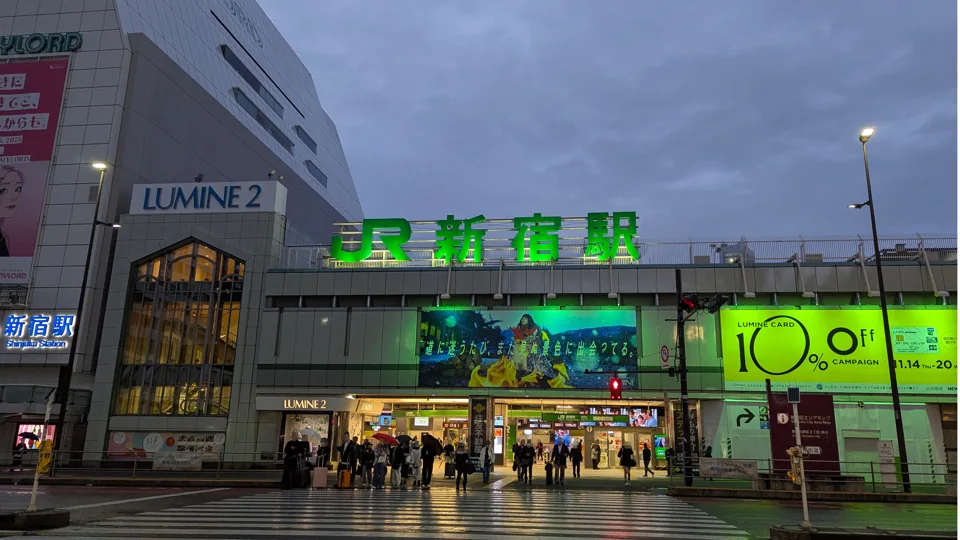
Image info
contri · 2024-11-18 · CC-BY-SA-2.0 · resized and cropped
¶From map to platform
Tokyo’s railways form a network of overlapping operators. You do not need to learn every line for the day. Choose the next train between origin and destination, then check the next line and ticket coverage when changing. A station name can contain several gates and exits; finish the journey by locating the building you actually want.
One ride: Tokyo to Shinjuku
From Tokyo Station to Shinjuku, choose between JR and the subway before looking for a platform. This example uses the Marunouchi Line: Tokyo is M17, identified by a red circle and M. Look for the Ogikubo direction and Shinjuku M08 on its stop list. The opposite platform heads towards Ikebukuro, so the correct colour alone is not enough.
Metro’s April 2026 example lists an 18-minute ride, ¥209 by IC or ¥210 by paper ticket/Tap to Ride, excluding the approach and wait. For Isetan, leave one stop earlier at Shinjuku-sanchome M09 and follow B3. The building you want can change the best station even on the same line.
Sources
- Tokyo Metro · Tokyo M17 station and directionsTokyo Metro · as of 2026-10-19
- Tokyo Metro · April 2026 route examplesTokyo Metro · as of 2026-10-19
- Tokyo Metro · Shinjuku-sanchome M09/F13 exitsTokyo Metro · as of 2026-10-19
From ticket machine to platform
For a paper ticket, select English under International Languages, then buy by destination or fare with cash. Collect the ticket at the entry gate and any machine change. With transport IC, touch the IC reader instead. Inside, match line, direction and platform number again: the station code M17 is not a platform number.
On a line with express or rapid services, check the stopping pattern as well as direction. Not every train going your way necessarily serves your stop. Showing the destination to staff and confirming the next train is more useful than memorising the entire network.
Sources
- Tokyo Metro · ticket machine, gates and platform signsTokyo Metro · as of 2026-10-19
Distinguish transfers from operator changes
Line colours help identify the train. Then check the operator and the scope of your ticket. A through train can cross an operator boundary without a change of vehicle; a transfer within one operator can still involve a walk outside the gates.
Sources
- Regular TicketsTokyo Metro · as of 2026-09-29
- Transfer TicketsTokyo Metro · as of 2026-09-29
- チャージ残額で乗車する場合の運賃の計算方法East Japan Railway Company · as of 2026-09-29
A real two-leg fare
Haneda T3 to Shinagawa costs ¥330 by Keikyu paper ticket. Add the ¥210 JR leg to Tokyo for ¥540. This is a two-leg sum, not a universal operator-boundary rule.
For the same route, IC totals ¥536: Keikyu ¥327 plus JR ¥209. Fare difference and transfer convenience are separate questions. Luggage and mobility needs can outweigh a small price difference.
Sources
- Fare and Time SearchKeikyu · as of 2026-09-29
- Haneda Airport T3 faresKeikyu · as of 2026-09-29
- Revised major section faresJR East · as of 2026-09-29
- Regular TicketsTokyo Metro · as of 2026-09-29
- Transfer TicketsTokyo Metro · as of 2026-09-29
Read the rules for gate-exit transfers
Listed Tokyo Metro gate-exit transfers have conditions including designated transfer gates and a 60-minute limit. This does not permit arbitrary exit and re-entry at every station. Metro–Toei connecting tickets also offer an adult ¥70 discount, so simply adding ordinary operator fares is not a universal rule.
Shinjuku-sanchome’s Marunouchi M09–Fukutoshin F13 connection is a concrete example. Follow the transfer signs outside the gates. With a paper ticket, use the orange transfer gate, collect the returned ticket and reinsert it within 60 minutes. For a designated IC gate-exit transfer, any automatic gate can be used, with re-entry on the same card within 60 minutes. Treat that as a transfer condition, not a restaurant break.
Sources
- Regular TicketsTokyo Metro · as of 2026-09-29
- Transfer TicketsTokyo Metro · as of 2026-09-29
- Tokyo Metro · paper-ticket transfer through an orange gateTokyo Metro · as of 2026-10-19
- Tokyo Metro · IC transfer outside the gatesTokyo Metro · as of 2026-10-19
- Tokyo Metro · Shinjuku-sanchome M09/F13 exitsTokyo Metro · as of 2026-10-19
IC and pass coverage
IC is a payment medium; a pass is a product with defined coverage. Tokyo Subway Ticket covers Metro and Toei, not JR. Check the actual operator and the product’s covered lines.
Tokyo Metro’s eligible bank-card Tap to Ride is also different from transport IC. It applies adult paper-ticket fares and requires the same card/device at entry and exit. It does not carry a through journey onto JR EAST.
Sources
- Tokyo Metro | Tokyo Subway TicketTokyo Metro Co., Ltd. · as of 2026-09-29
- Tap to RideTokyo Metro · as of 2026-09-29
If a gate closes or the route is wrong
For an underpaid paper ticket, use the fare-adjustment machine near the exit and take the replacement ticket through the gate. Top up an insufficient IC balance before retrying. If you have the wrong operator’s gate or may have exited incorrectly, show staff the origin, destination and original ticket/card before starting again with another card. Keep the medium holding the entry record available.
At the destination, switch from transfer signs to the exit number and vicinity map. Pairing a building with an exit—B3 for Isetan, B2/C3 towards Suehirotei—reduces backtracking above ground. If you need a lift, use the station’s accessibility map rather than assuming the nearest stair exit is suitable.
Sources
- Tokyo Metro · transfers, exits and fare adjustmentTokyo Metro · as of 2026-10-19
- Tokyo Metro · Shinjuku-sanchome M09/F13 exitsTokyo Metro · as of 2026-10-19
Sources & freshness
Last update 2026-10-02
Sources
Key fare, transfer and card-coverage terms rechecked: 2026-10-18, against operators’ fare tables and product guidance. This does not guarantee actual services, waiting times, last connections or an accessible route; check the guidance for your travel date.