Shibuya · Harajuku · Yoyogi / LENS
Small architecture for urban pauses
Choose among Ando's shared canopy, Ito's three roofs and Kuma's five cedar huts by their facilities and the neighbourhood you will visit.
Three separate sites in Jingu-Dori Park, Yoyogi-Hachiman and Shoto. Allow an estimated 5–10 minutes for one exterior; all are free public facilities.
Compare Ando's circular canopy and louvers, Ito's three structures and circulation spaces, and Kuma's five timber-clad huts. See how the same public function addresses light, circulation and the park differently.
COMPARE · What differs
LENS · Where the lens sits
Where are this lens’s places, and can one walk tie them together?
Spread apart · two quarters (Shibuya Station · Jinnan; Yoyogi Park · Tomigaya) · the farthest two about 27 min on foot
Places in this lens
- Jingu-Dori Park — THE TOKYO TOILET — Shelter within a circle · Shibuya Station · Jinnan
- Yoyogi-Hachiman — THE TOKYO TOILET — Three forms by the woods · Yoyogi Park · Tomigaya
- Nabeshima Shoto Park — THE TOKYO TOILET — Five huts and a path · Shibuya Station · Jinnan
Walking times are estimates from OpenStreetMap’s surface street network at 80 m/min. They exclude underpasses, decks, station concourses, signal waits, slopes and movement inside buildings. Straight-line links are not walking routes; follow on-site signs even where a time is shown. Shaded quarters show the approximate areas around FOW’s selected places.
Map data: © OpenStreetMap contributors (ODbL) · Quarter names and character: FOW · Town names: each place’s official address · Walking: computed by FOW · 2026-10-16
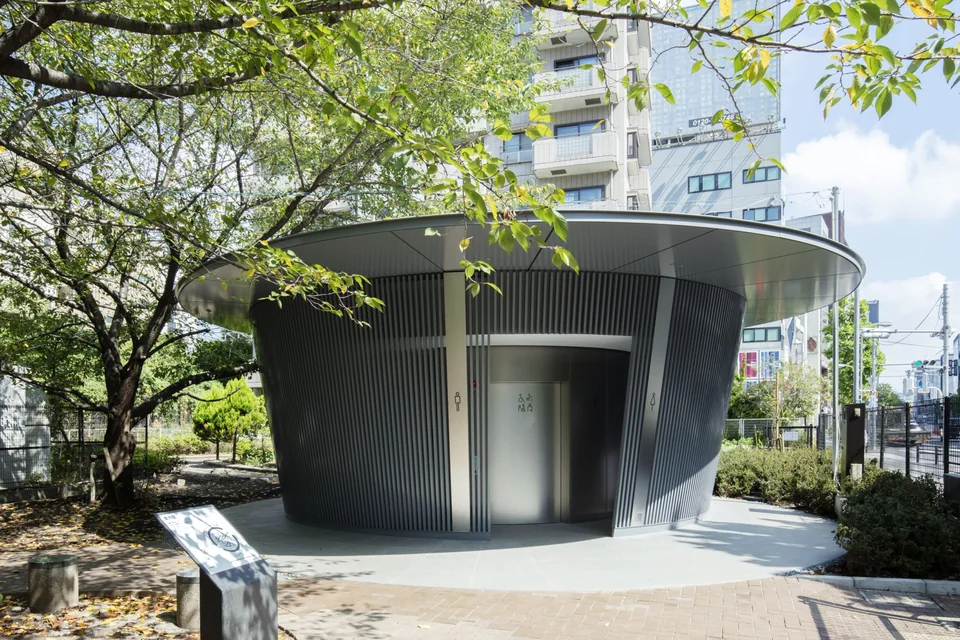
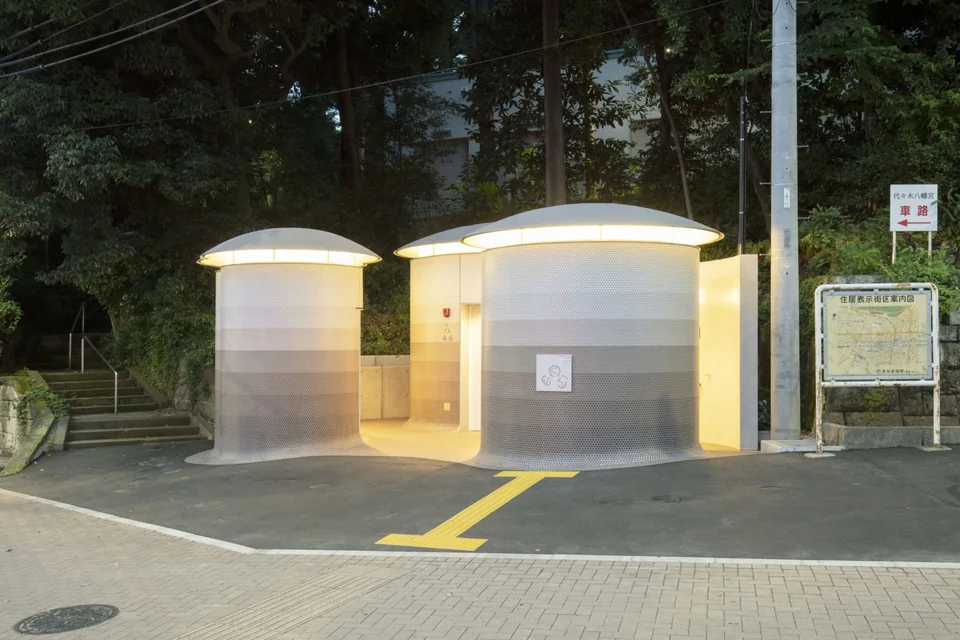
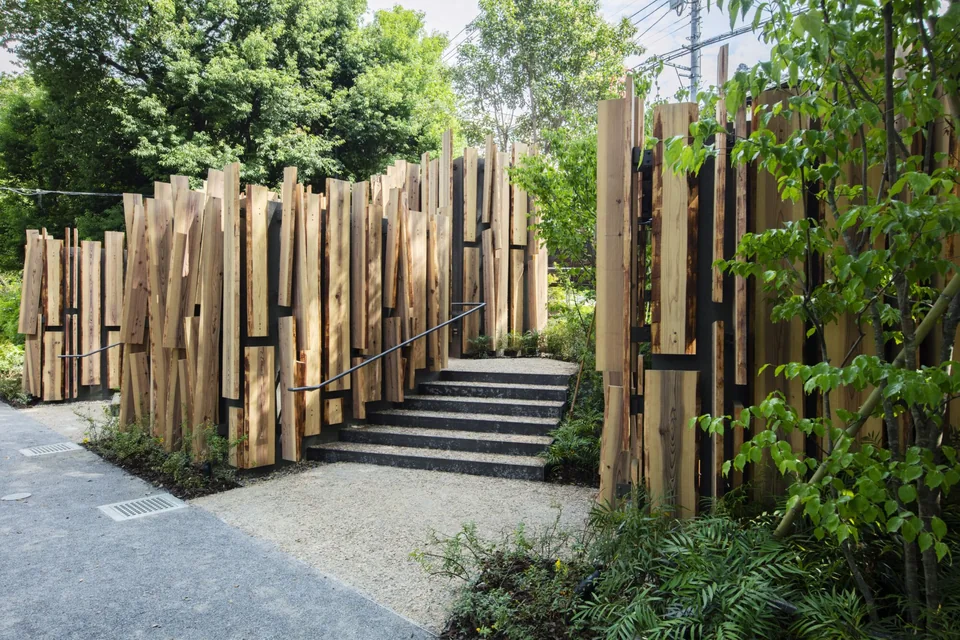
Image info
Satoshi Nagare · resized and croppedSmall architecture for urban pauses
Jingu-Dori Park — THE TOKYO TOILET
Observe wind, light and circulation through Tadao Ando's circular louvered public structure.
Continue with this place ↗Choose Ando for a Shibuya walk, Ito with the shrine, or Kuma for timber and paths in Shoto Park.
One canopy or separate buildings
On a Shibuya or Jinnan day, begin with Ando's AMAYADORI in Jingu-Dori Park. Its name means sheltering from rain: a broad circular roof projects beyond vertical louvers that admit light and air. North and south openings maintain a through-route. From the south, the projecting eaves reveal the space available for a pause. Sinks line the passages to the men's and women's facilities; the central accessible room at the station-side entrance includes ostomate equipment, a baby chair and changing table.
For a shrine visit, choose Ito's Three Mushrooms at 5-1-2 Yoyogi, beside Yamate-dori at the foot of Yoyogi Hachimangu's steps. Three rounded roofs stand separately against the woods. Gaps beneath them admit daylight, and small circular tiles form colour gradients. Paths connect without dead ends, while facilities for older people and parents with children are distributed into the men's and women's rooms. Ando gathers functions beneath one canopy; Ito leaves space between buildings.
Walking between cedar walls in Shoto
Kuma's contribution in Nabeshima Shoto Park connects five small buildings by paths. It uses 240 natural-edged Yoshino cedar boards set at different angles, so overlaps and openings change as you move. See the group from the largest entrance, then the roofs and greenery from the side steps.
The interiors differ too: child-sized toilets and a small urinal in the children's room; ostomate equipment, a baby bed and chair in the accessible room. Reused cherry and metasequoia appear inside. Choose it for a Shoto Park walk with time to move between structures. The address is 2-10-7 Shoto.
Choose the site that fits the day
These are free working public toilets, without exhibition tickets. Ando is at 6-22-8 Jingumae between Shibuya and Harajuku; Ito is directly below Yoyogi Hachimangu; Kuma is inside a Shoto neighbourhood park. Five to ten minutes for one exterior is this guide's allowance. Match the neighbourhood and useful facilities to your day rather than adding travel solely to complete three sites.
Use the signs to find the room you need and give users privacy and clear access. Maintenance can close facilities; do not plan around unrestricted interior viewing at any hour.
Working public toilets: keep access clear, do not photograph users and follow maintenance notices.
- Visit conditions
- Give users privacy and clear access; follow maintenance notices and facility signs.
Sources · image info
- https://tokyotoilet.jp/en/tokyotoilet.jp · as of 2026-10-06
- https://www.oneclub.org/awards/theoneshow/-award/47891/the-tokyo-toilet/www.oneclub.org · as of 2026-10-06
- THE TOKYO TOILET — project and facility captionstokyotoilet.jp · as of 2026-10-19
- THE TOKYO TOILET — project and facility captionstokyotoilet.jp · as of 2026-10-19
- THE TOKYO TOILET — project and facility captionstokyotoilet.jp · as of 2026-10-19
- Jingu-Dori Park — THE TOKYO TOILET — Satoshi Nagare · resized and cropped
- Yoyogi-Hachiman — THE TOKYO TOILET — Satoshi Nagare · resized and cropped
- Nabeshima Shoto Park — THE TOKYO TOILET — Satoshi Nagare · resized and cropped