Shinjuku / PLACE
Shinjuku Gyoen National Garden
A long lawn vista, symmetrical roses and plane trees, and paths around ponds: three garden traditions meet across 58.3 hectares.
Visit fitAnyone with half a day to walk · seasonal plants and garden-style enthusiasts
Completed as an imperial garden in 1906 and opened as a national garden in 1949: 58.3 ha, with a Western layout by Henri Martinet of the Versailles horticultural school, about 900 cherry trees of 70 varieties and a greenhouse of over 1,000 species.
The Shinjuku skyline rising beyond the English lawn — garden and city in one frame. Look for the 1896 Western-style rest house (Important Cultural Property) and the Taiwan pavilion.
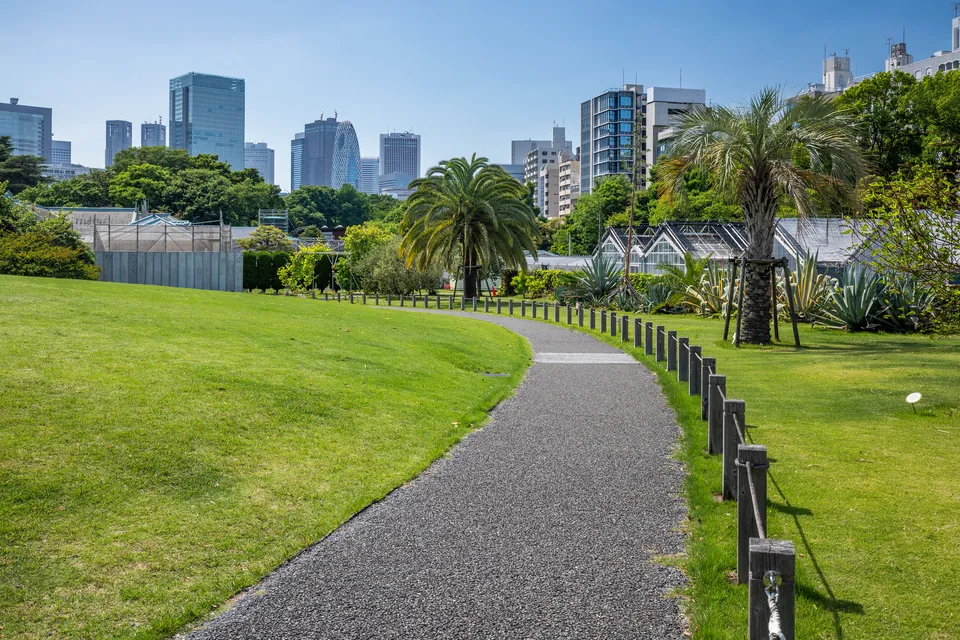
Image info
Ximonic (Simo Räsänen) · 2024-05-18 · CC-BY-SA-4.0 · resized and cropped
Three ways to arrange a garden
Shinjuku Gyoen became an imperial garden in 1906 and opened to the public in 1949. The landscape garden opens a long view across lawn and large trees. The formal garden sets about 140 plane trees in four symmetrical rows around roses; the Japanese garden changes the scene along paths around large ponds. The contrast lies in how each layout directs movement and sight. Follow the change from a straight vista to a curved pond path, rather than treating the whole garden as one backdrop.
WHERE · On foot from here
Which gate to use
A large walled garden: the gate you choose decides your route. There are three gates, and each one is closest to a different station.
Official guidance
- Shinjuku Gate · 新宿門
- 5 min from Exit 1, Shinjukugyoemmae (Marunouchi Line)
- 5 min from Exit E5, Shinjuku-sanchome (Fukutoshin Line)
- 5 min from Exits C1/C5, Shinjuku-sanchome (Toei Shinjuku Line)
- 10 min from the South Exit, Shinjuku (JR, Keio, Odakyu)
- Okido Gate · 大木戸門
- 5 min from Exit 2, Shinjukugyoemmae (Marunouchi Line)
- Sendagaya Gate · 千駄ヶ谷門
- 5 min from Sendagaya Station (JR Sobu Line)
- 5 min from Exit A5, Kokuritsu-kyogijo (Oedo Line)
- 10 min from Exit 1, Kita-sando (Fukutoshin Line)
Read together
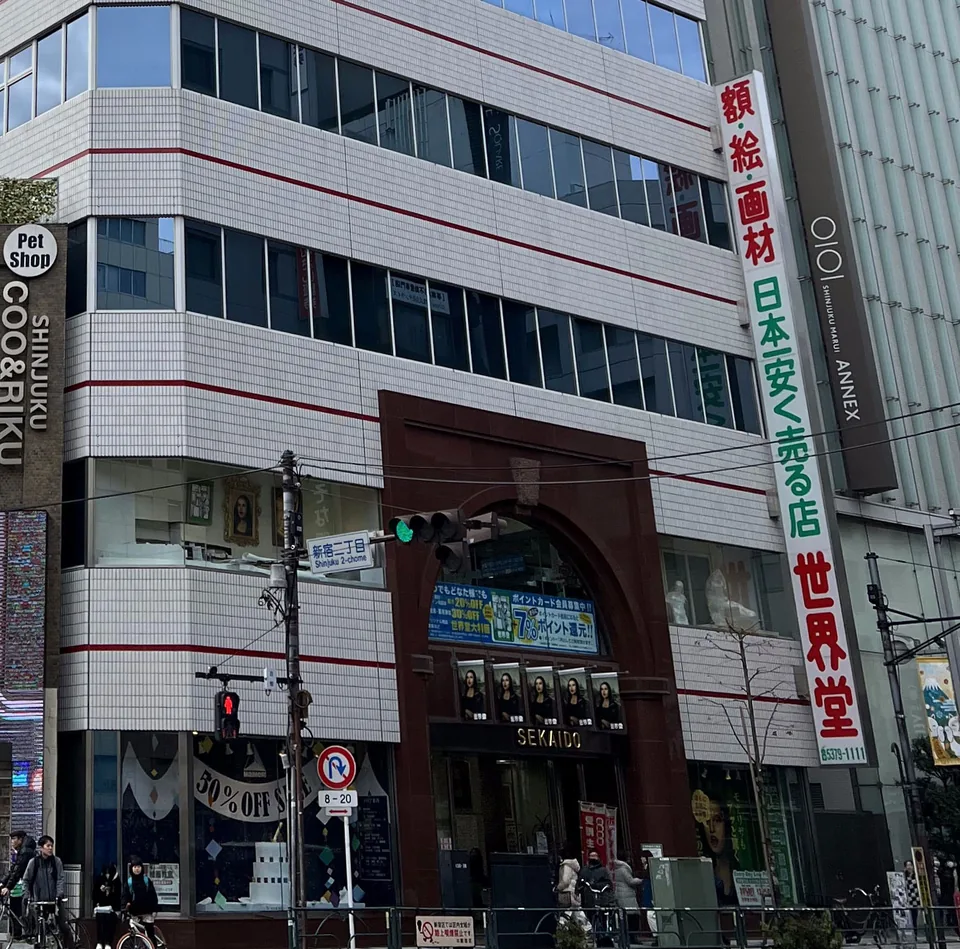
- Sekaido Shinjuku Main Store — Not plotted · exact location unconfirmed
Walking bands are computed by FOW on the OpenStreetMap surface street network at 80 m/min and drawn as a smoothed approximate area around the streets reached. They ignore exit positions, station interiors, underground passages, signals, slopes and routes inside buildings — not directions; follow on-site signs.
Map data: © OpenStreetMap contributors (ODbL) · Walking bands: computed by FOW · Station and gate notes: official guidance (2026-10-16)
A first circuit from Shinjuku Gate
After shopping on the Shinjuku side, enter at Shinjuku Gate, begin with the Japanese garden and ponds, then emerge onto the landscape garden’s lawn. Extend east to the formal garden and plane-tree avenue if you have more time. A tulip tree over 30 m tall marks the vista running from Shinjuku Gate towards the formal garden. This guide suggests 60 minutes for a shorter garden walk or 90–120 minutes to connect all three areas. Autumn roses and foliage depend on the season’s weather, so use the current highlights notice.
Greenhouse, architecture and the gate ticket
For plant forms, add the greenhouse, which cultivates about 2,700 species, mainly tropical and subtropical. In the Japanese garden, the Chinese-style former Goryotei pavilion and the Rakuutei and Shoten-tei teahouses add architectural frames to the ponds. Their public hours and tea service differ from the garden’s overall hours. Standard admission is ¥500; tea and meals are separate purchases. In late autumn, entry closes at 16:00, so work back from that cutoff if shopping comes first. Follow the prohibited-item rules below, including alcohol and sports equipment.
Read it with
Before you go
- Hours and fees
- Adult admission is ¥500; ages 65+ and students 16+ pay ¥250; ages 15 and under enter free. Hours: 1 October–14 March 09:00–16:30 (last entry 16:00); 15 March–30 September 09:00–18:00 (17:30), except 11 June–31 July 09:00–19:00 (18:30).
- Good to know
- Closed Mondays (next weekday after a holiday) and 29 December–3 January. Open daily 25 March–24 April and 1–15 November. Busy cherry-blossom dates may require booking. Alcohol, bicycles and pets are prohibited; assistance dogs are excepted.
- Access
- Free wheelchair loans and accessible toilets. Some paths have gravel, slopes or steps; use the gate’s barrier-free guide and UD map.
Sources · image info
- Access | Shinjuku GyoenJapan Ministry of the Environment · as of 2026-09-29
- Admission | Shinjuku GyoenJapan Ministry of the Environment · as of 2026-09-29
- GSI AddressSearch JSON: 新宿御苑Geospatial Information Authority of Japan · as of 2026-09-29
- Garden Rules | Shinjuku GyoenJapan Ministry of the Environment · as of 2026-09-29
- Universal Design | Shinjuku GyoenJapan Ministry of the Environment · as of 2026-09-29
- Shinjuku Gyoen — garden styles and greenhouseNational Gardens Association · as of 2026-10-19
- Shinjuku Gyoen — representative gardensMinistry of the Environment · as of 2026-10-19
- Ministry of the Environment, Japan ↗
- Ministry of the Environment, Japan ↗
- Ministry of the Environment, Japan ↗
- Ministry of the Environment, Japan ↗
- Shinjuku Gyoen — Ximonic (Simo Räsänen) · 2024-05-18 · CC-BY-SA-4.0 · resized and cropped
- Sekaido — Asanagi · 2024-01-28 · CC0-1.0 · resized and cropped
- Chuo Park — Mikhail Kotykhov · 2024-12-12 · CC0-1.0 · resized and cropped
- SOMPO Museum — Asanagi · 2024-01-25 · CC0-1.0 · resized and cropped
- ICC — Kakidai · 2024-11 · CC-BY-SA-4.0 · resized and cropped


