Shibuya · Harajuku · Yoyogi / PLACE
Yoyogi Hachimangu
Yoyogi Hachimangu brings remnant woodland together with traces of habitation around 5,000 years ago.
Add the hill’s human history to a walk among trees.
Visit fitFor adding local history to a neighbourhood walk. Approach it as a religious place, not simply a photographic setting.
A reconstructed Jomon dwelling and a 1909 farewell lantern connect different periods of local life.
Relate the dwelling to the memorial of residents moved for a military ground on the present park site.
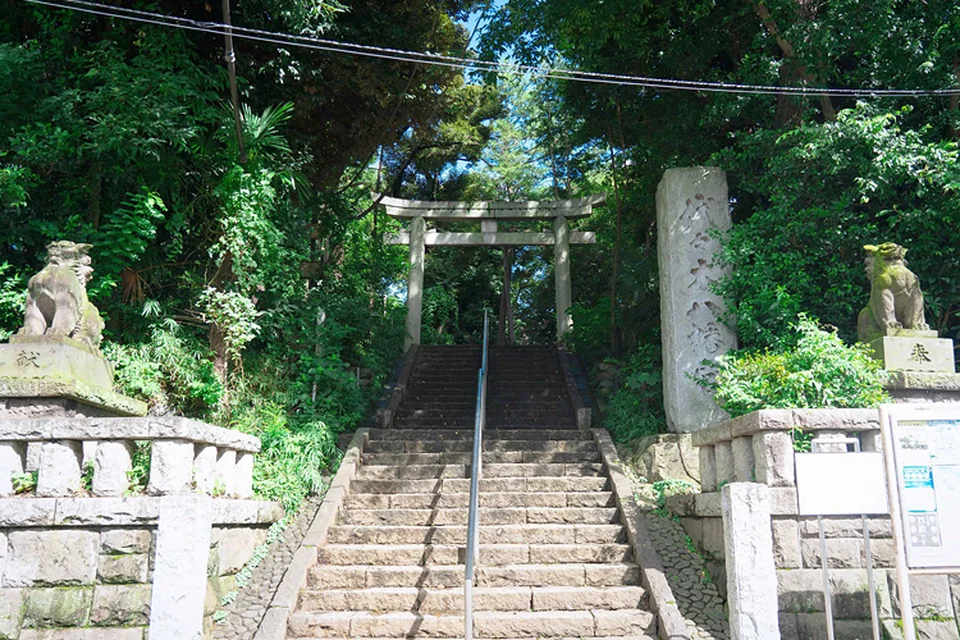
Image info
yoyogihachimangu.or.jp · resized and croppedA shrine above an older settlement
Yoyogi Hachimangu venerates Hachiman, associated with Emperor Ojin. Its founding tradition dates to 1212 and a dream of Arai Geki Tomoaki, followed by enshrinement from Tsurugaoka Hachimangu. The hill's human history reaches further back: a 1950 excavation found roughly 5,000-year-old Jomon dwelling remains, postholes, pottery and stone tools. The reconstructed dwelling on the 32 m hill adds an earlier settlement to the shrine visit.
WHERE · On foot from here
How far from the station, and which side
North of Yoyogi-Hachiman Station, about 250 m in a straight line from the station area. The mark is a verified point, not the entrance. The shaded areas are about 5 and 10 minutes on foot from here.
Walking bands are computed by FOW on the OpenStreetMap surface street network at 80 m/min and drawn as a smoothed approximate area around the streets reached. They ignore exit positions, station interiors, underground passages, signals, slopes and routes inside buildings — not directions; follow on-site signs.
Map data: © OpenStreetMap contributors (ODbL) · Walking bands: computed by FOW · Station and gate notes: official guidance (2026-10-16)
Trees and objects of local history
Chinquapin, camphor, zelkova and ginkgo preserve a remnant of Musashino's natural forest. After worship, the reconstructed dwelling and monuments make a useful sequence. Large votive paintings donated in 1840 and 1841 are local folk-cultural properties, their forceful figures compared with theatrical painting. The 1909 farewell monument is a stone lantern donated by residents displaced for a military training ground on today's Yoyogi Park site. Those objects connect the forest to changes in the neighbourhood.
Allow for different reception hours
At 5-1-1 Yoyogi, the shrine lists a five-minute walk from Yoyogi-Hachiman or Yoyogi-Koen's Uehara-side exit. Allow an estimated 30–45 minutes for worship and the grounds. The office opens 09:00–17:00 and prayer reception 09:00–16:30. Some excavated objects are kept in the display room beside the kaguraden, but its opening times remain unverified. Call 03-3466-2012 if artefacts are the main purpose and give ceremonies priority.
Before you go
- Hours and fees
- 5-1-1 Yoyogi. Shrine office 09:00–17:00, prayer reception 09:00–16:30. The operator lists a five-minute walk from Yoyogi-Hachiman or Yoyogi-Koen’s Uehara-side exit. Gate and artefact-display hours remain unconfirmed; call 03-3466-2012 if the display is your purpose.
- Good to know
- Respect worship and ceremony routes. The artefact display room and shrine office have separate hours.
Sources · image info
- Yoyogi Hachimangu: forest, archaeology and monuments · as of 2026-10-19
- Yoyogi Hachimangu official address/accesswww.yoyogihachimangu.or.jp · as of 2026-10-19
- https://www.gotokyo.org/en/spot/702/index.htmlwww.gotokyo.org · as of 2026-10-06
- Yoyogi Hachimangu official reception hourswww.yoyogihachimangu.or.jp · as of 2026-10-19
- Yoyogi Hachimangu: founding tradition · as of 2026-10-19
- Yoyogi Hachimangu — yoyogihachimangu.or.jp · resized and cropped