Shibuya · Harajuku · Yoyogi / PLACE
WATARI-UM
Read Mario Botta’s striped facade alongside contemporary art, grounded in Shizuko Watari’s collection and collaborations with artists.
Start with Mario Botta’s striped facade, then see how its geometry meets exhibitions using image and light.
Visit fitFor combining architecture and contemporary art in one visit; choose an exhibition that interests you.
Its 2026 Paik exhibition used New Candle’s camera and projectors and Cage’s Forest’s monitors among plants to explore video, life and time.
Look at the granite-and-concrete stripes and geometry, then at how the exhibition places light and screens within the rooms.
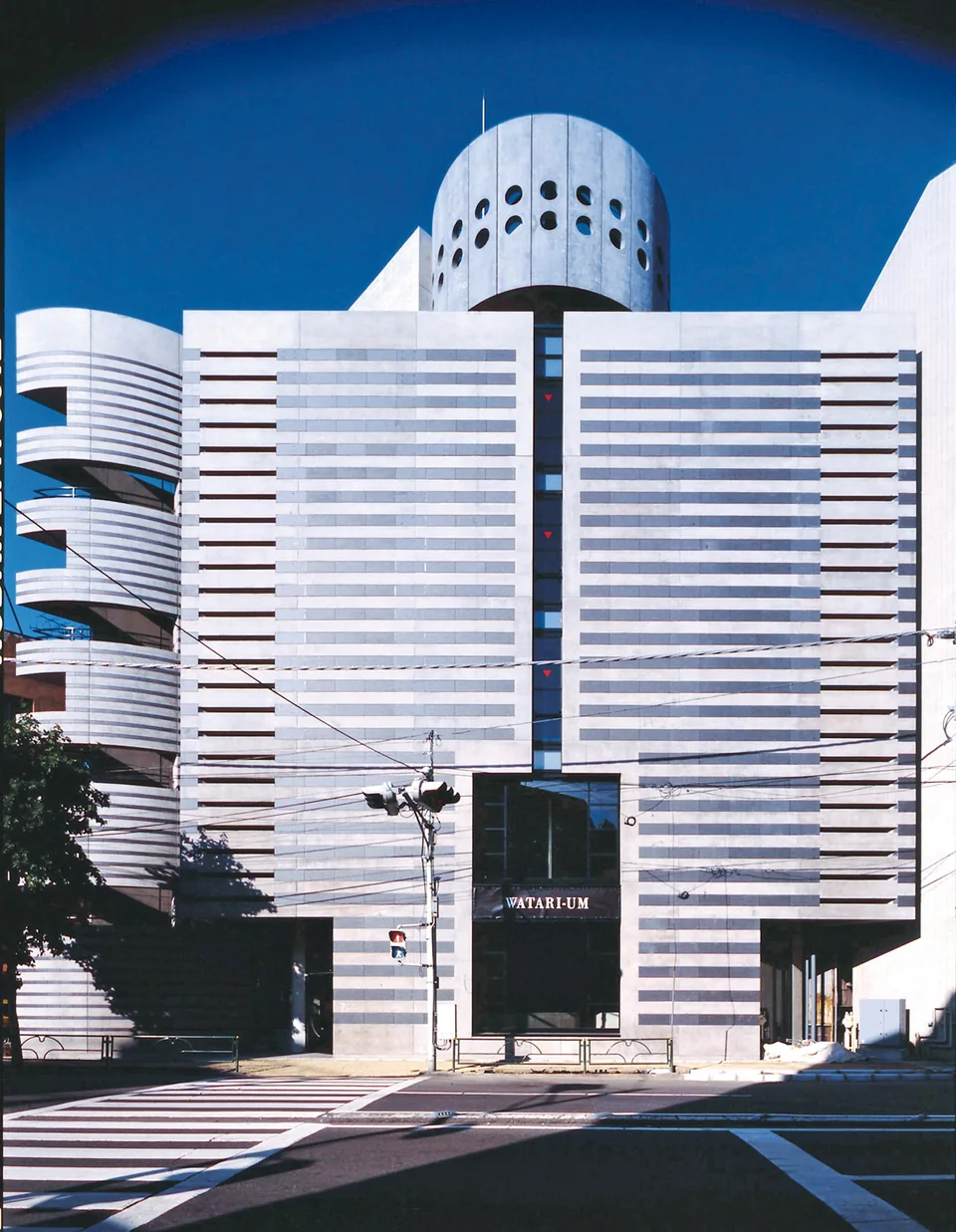
Image info
Casa BRUTUS / Magazine House · resized and croppedCandles and monitors inside the striped building
WATARI-UM's stripes alternate granite and concrete. Swiss architect Mario Botta designed the museum, with curator Harald Szeemann advising; it opened in 1990, building on Shizuko Watari's earlier gallery and collection.
The museum’s 2026 Nam June Paik: Jugemu exhibition linked the long life of artworks to a rakugo story about an extraordinarily long name. New Candle (1993) uses a candle, one camera and four projectors; Cage’s Forest/Forest Revelation (1993) combines plants, twenty monitors and three-channel video. TV Egg (1982) used glass, a lens and one monitor. These give concrete starting points beyond the label 'video art': a small flame becomes an image, while screens share space with living plants.
WHERE · On foot from here
How far from the station, and which side
West of Gaiemmae Station, about 400 m in a straight line from the station point. The shaded areas are about 5 and 10 minutes on foot from here.
Walking bands are computed by FOW on the OpenStreetMap surface street network at 80 m/min and drawn as a smoothed approximate area around the streets reached. They ignore exit positions, station interiors, underground passages, signals, slopes and routes inside buildings — not directions; follow on-site signs.
Map data: © OpenStreetMap contributors (ODbL) · Walking bands: computed by FOW · Station and gate notes: official guidance (2026-10-16)
Choose an exhibition and an approach
Choose a programme through the official exhibition information, which gives its works and admission terms. If architecture is part of the visit, allow time for the facade as well as the galleries.
At 3-7-6 Jingumae, official walks are seven minutes from Gaienmae Exit 3, nine from Omotesando A2 and fourteen from Harajuku's Takeshita Exit. Allow for the walk as well as time with the video works.
Before you go
- Hours and fees
- 3-7-6 Jingumae. Use the official exhibition information for hours, admission and closures. Official walks are seven minutes from Gaienmae Exit 3, nine from Omotesando A2 and fourteen from Harajuku’s Takeshita Exit.
- Good to know
- Works and visit conditions change with each exhibition; plan around its official listing.
Sources · image info
- https://casabrutus.com/data/architectures/313025casabrutus.com · as of 2026-10-06
- Nam June Paik: Jugemuwww.watarium.co.jp · as of 2026-10-19
- https://www.artweektokyo.com/institution-gallery/watari-um-ja/www.artweektokyo.com · as of 2026-10-06
- WATARI-UM building and historywww.watarium.co.jp · as of 2026-10-19
- WATARI-UM station accesswww.watarium.co.jp · as of 2026-10-19
- WATARI-UM — Casa BRUTUS / Magazine House · resized and cropped